 Systemic Studios
Which way should my aerial point?
Point the aerial at the Freeview transmitter that serves your area. Hills often decide which one that is, so check that no hill blocks the path, then fine-tune and retune every TV.
Point it at the transmitter that serves you, along a path clear of hills, with the elements matching its polarisation.
Six practical steps, from finding your transmitter to the final retune. Each one shows how to do it with Tower Aim, our app, using RSM data.


No ads, no account.
Read this, then follow the steps below for the detail.
Point the aerial at the Freeview transmitter that serves your area. Hills often decide which one that is, so check that no hill blocks the path, then fine-tune and retune every TV.
Systemic Studios makes Tower Aim, the app this guide uses for each step. Roof work is dangerous: if your aerial is hard to reach, use a professional aerial installer.
Do steps 1 to 4 on the ground, before you get the ladder out.
Your aerial should face the transmitter that serves you, which is not always the closest or the most powerful. Tower Aim recommends one based on published power and distance, not a signal measurement, from RSM Register of Radio Frequencies data dated 14 October 2026: 156 Freeview transmitters across 33 sites, five multiplexes. Search by suburb, town or postcode, or use your location.
Hills often decide which transmitter serves you. Tower Aim lists the transmitters nearby with the terrain to each, so you can compare before you climb.
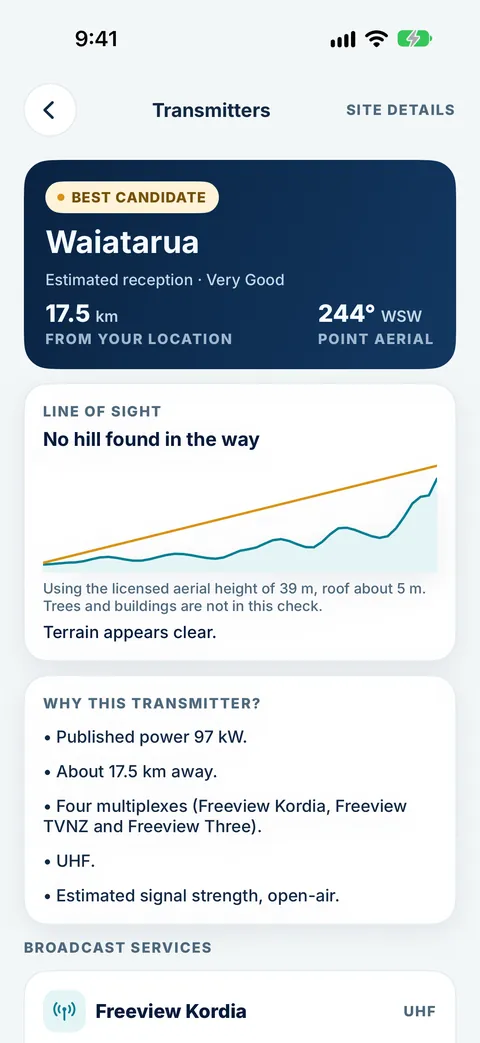
Most sites are horizontal and some are vertical. Turn the aerial so its elements match. Tower Aim shows the polarisation, UHF channel and power for each multiplex.
Tower Aim shows the elevation profile along the path, from a one-time terrain download. Tower Aim Installer adds finer terrain. Trees and buildings are not included, so treat it as a guide.
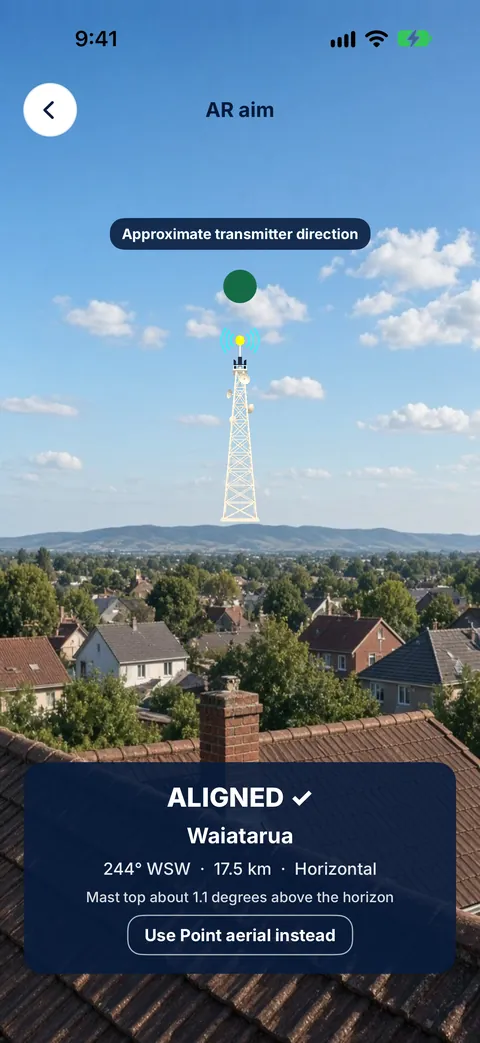
Face the bearing shown and follow the live compass arrow until it confirms you are on target. AR aiming works on supported phones.
Turn in small steps while someone watches the signal screen on the TV, then run a full retune on every TV.
No ads, no account.
What to check at each step, and where to find it in the app.
| Step | What to check | In Tower Aim |
|---|---|---|
| 1. Find your transmitter | Which transmitter serves you | A recommended transmitter based on published power and distance, not a signal measurement, with estimated reception; RSM data dated 14 Oct 2026; search by suburb, town or postcode |
| 2. Nearby transmitters | Whether a hill blocks the path | Nearby transmitters on the map and in a list, with the terrain to each |
| 3. Polarisation | Horizontal, vertical or mixed | Shown for each multiplex, with its UHF channel, frequency and power |
| 4. Terrain | Hills between you and the transmitter | Elevation profile from a one-time terrain download; finer terrain with Installer |
| 5. Aim | The bearing to the transmitter | Live compass arrow that confirms when you're on target; AR aiming on supported phones |
| 6. Fine-tune and retune | Signal quality on the TV, then a retune | Channel numbers and frequencies for each transmitter |
| On the roof | What's saved on your phone | Transmitter data built in; one-time terrain download |
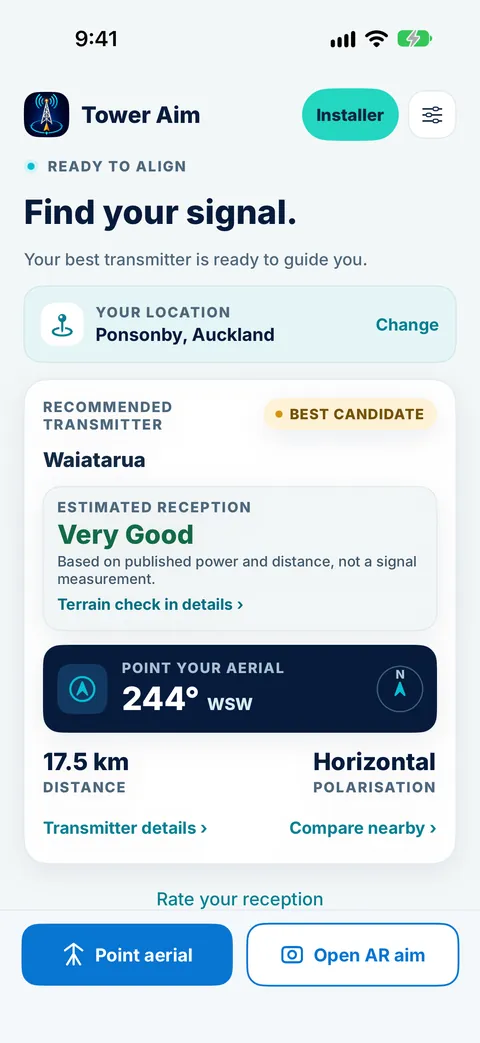
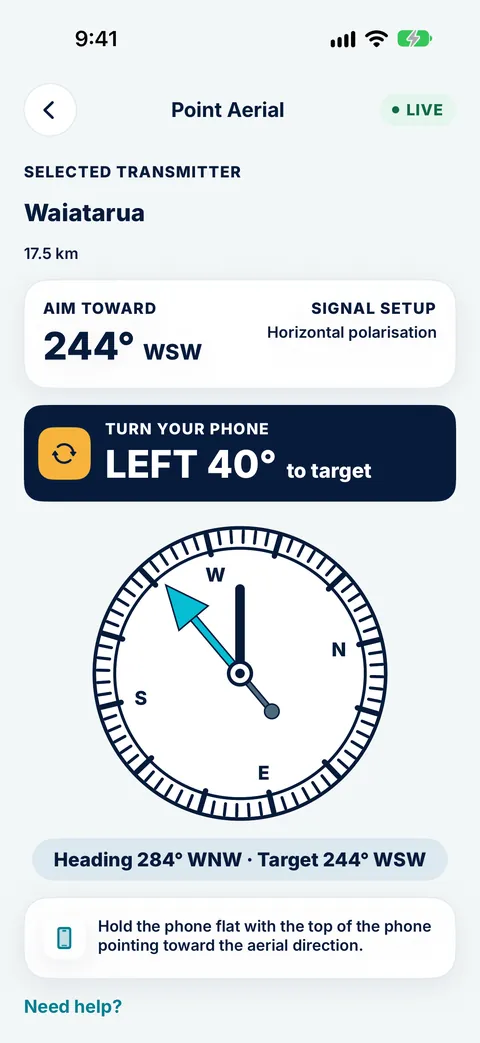
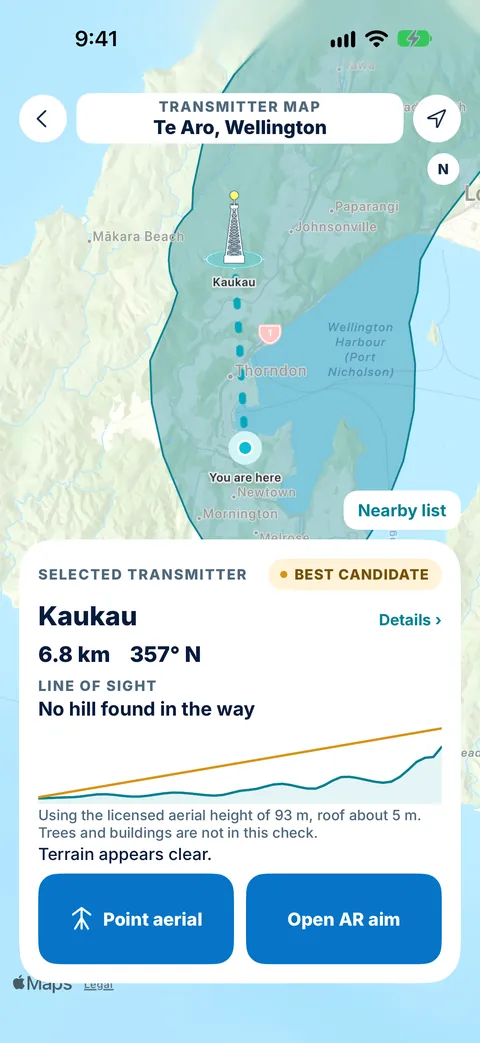
Real Tower Aim screens in Auckland and Wellington.
In Te Aro, Wellington, Tower Aim picks Kaukau with a clear path over the hills.
In Ponsonby, Auckland, the details for Waiatarua show its power, multiplexes and polarisation.
Follow the compass arrow, or AR aim on supported phones, while you turn the aerial, then check reception on your TV.
Small habits that make the job quicker and safer.
Only work on a roof if you can do it safely, never alone and never in wind or rain. If the aerial is high or hard to reach, use a professional aerial installer.
Look up the transmitter, bearing, polarisation and terrain in Tower Aim before you climb, so the time on the roof is just aiming.
If the arrow seems off, move the phone in a figure-eight to calibrate it, and keep it away from metal and magnets, including magnetic phone cases.
Aerials nearby usually point at the same transmitter. If yours faces a different way, or its elements are the other way up, find out why before you change it.
TV signal readouts lag a little. Turn a few degrees at a time and pause before you judge the picture.
Some UHF channels that used to carry TV are now used by 4G and 5G. If the picture breaks up near a mast, especially with an amplifier, a 4G/5G filter can help.
Tower Aim: TV Aerial Finder
We make it. These are the parts that match the steps above.
No ads, no account.
RSM Register of Radio Frequencies data dated 14 October 2026: 156 Freeview transmitters across 33 sites, five multiplexes. The recommended transmitter is based on published power and distance, not a signal measurement.
Tower Aim lists the transmitters nearby, with the terrain to each, so you can compare.
Search by suburb, town or postcode, or use your location.
A terrain line of sight from a one-time terrain download, with finer terrain in Tower Aim Installer.
A live compass arrow that confirms when you're on target, plus AR aiming on supported phones. Then check reception on your TV.
Aerial installers, electricians and AV professionals can add Tower Aim Installer, an optional subscription, for jobs, readings from your own meter, photos and branded PDF reports.
Confirm the transmitter, record the job and hand over a report on site.
Jobs, readings, photos and PDF reports, step by step.
Features, screenshots, Tower Aim Installer and support.
At the transmitter that serves your area, with the elements matching its polarisation. Tower Aim recommends a transmitter based on published power and distance, not a signal measurement, and shows the bearing, polarisation and terrain to it.
Not always. A more powerful transmitter further away, or one with a clear path over the hills, can serve you better than a small one nearby. Tower Aim recommends a transmitter based on published power and distance, so check the terrain to each option too.
Match the transmitter you are aiming at. Most sites are horizontal and some are vertical. On a horizontal aerial the elements lie flat; on a vertical one they stand upright.
From Radio Spectrum Management (RSM) at MBIE, using the current UHF television licences in the Register of Radio Frequencies, dated 14 October 2026. It covers 156 Freeview transmitters across 33 sites, with five multiplexes.
Yes. Search by suburb, town or postcode, or use your location.
The transmitter data is built into the app, and the terrain map is a one-time download that stays on your phone. Open the app once on Wi-Fi before you head up.
No. Your phone cannot measure TV signal. Tower Aim recommends a transmitter based on published power and distance, and shows "Estimated reception" from Excellent to Poor. It is an estimate, not a measurement. Installers can record readings from their own meter with Tower Aim Installer.
iPhone with iOS 17 or later, and Android 8.0 or later.
No ads, no account.